

Across Asia, marketplace affiliate programs have evolved into a core mechanism for monetizing eCommerce traffic. In many markets, the marketplace is no longer just a sales channel — it is the primary shopping layer where demand, logistics, payments, and promotions converge within a single platform ecosystem.
For affiliates, this changes how eCommerce offers are promoted. Instead of driving traffic to a single retailer with a fixed catalog, they operate inside large marketplace infrastructures with their own attribution rules, commissions, and payout logic. These internal mechanics ultimately determine whether a campaign can scale or quickly become fragile.
This is why the structure of a program matters just as much as the GEO or traffic source used to promote it. Two accounts may look similar on the surface, yet behave very differently once you start running campaigns.
In this article, we examine affiliate programs across the most visible eCommerce platforms in Asia — including Southeast Asia’s core marketplaces, domestic leaders from India and Japan, and global cross-border players. The goal is not to rank brands by popularity, but to understand how each platform’s terms translate into workable acquisition and monetization strategies.
Asia’s eCommerce Growth in Numbers
eCommerce growth is no longer evenly distributed across regions — the center of gravity has shifted toward Asia.
According to ECDB’s Global eCommerce Outlook 2026, global online retail sales are projected to exceed $5 trillion in 2026, marking another structural milestone for the industry. After the volatility of the pandemic years, the market has entered a more stable phase. Global eCommerce grew by 9.8% in 2025, and ECDB expects a further 8.6% expansion in 2026.
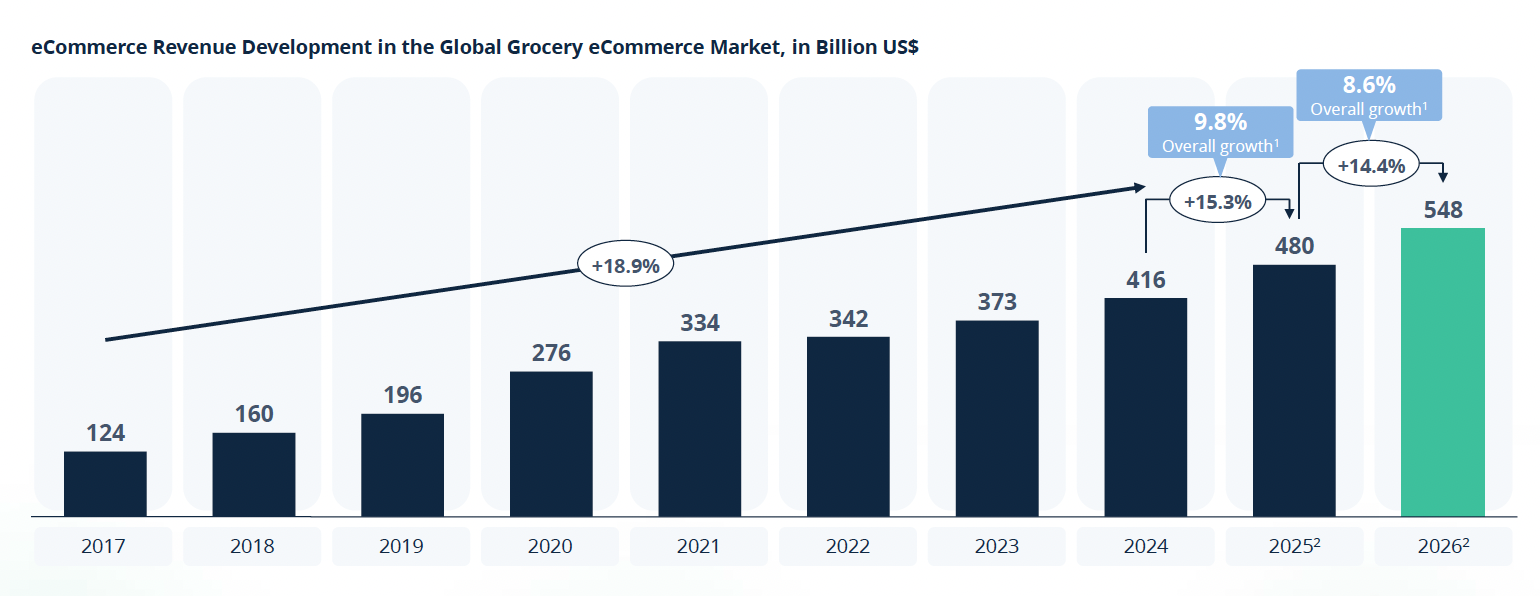
Source: ECDB’s Global eCommerce Outlook 2026
Within that global total, APAC remains the largest regional contributor — and follows a different model than Western markets.
According to ECDB’s Global eCommerce Trends 2025 report, the most recent full-year data shows that in 2024, marketplaces generated about 97% of eCommerce revenue in Asia, while standalone online stores accounted for only around 3%.
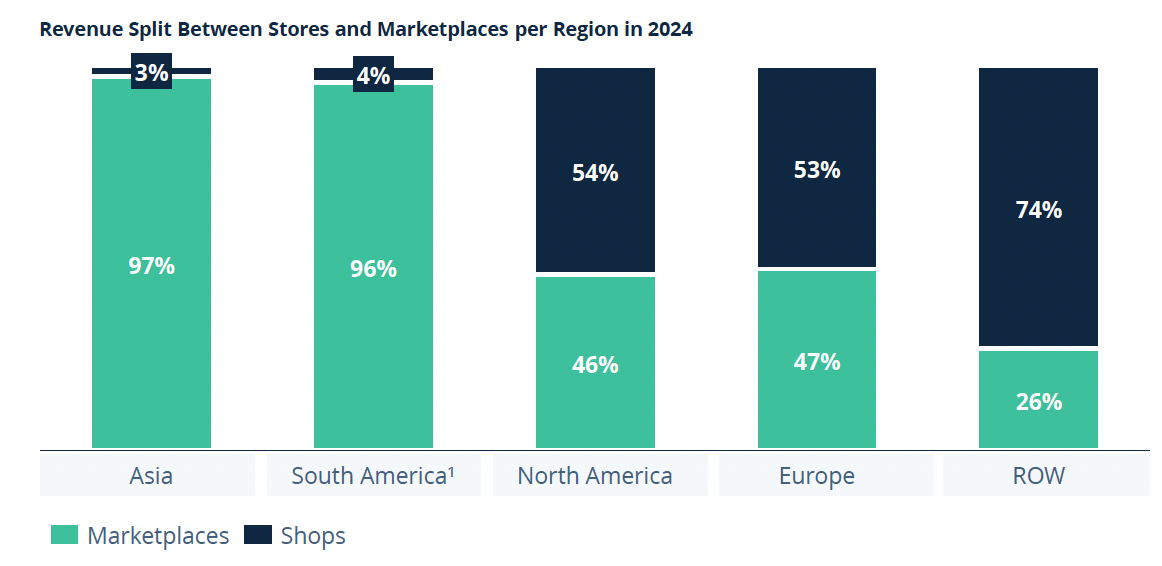
Source: ECDB’s Global eCommerce Trends 2026
This dominance is significantly stronger than the global average. ECDB’s Global eCommerce Outlook 2026 projects that marketplaces will represent around 87% of global eCommerce revenue in 2026, highlighting how strongly Asian markets are structured around platform ecosystems.
This concentration reshapes the affiliate strategy. Instead of working with isolated brand stores, affiliates operate inside multi-seller environments where product depth, logistics, and payments are consolidated at the platform level.
The regional growth outlook confirms that this momentum is not temporary.
According to ECDB projections, Indonesia’s eCommerce market expanded rapidly in 2025 and is expected to grow by a further 22.0% in 2026, while India is forecast to expand by 17.6% in 2026 — both significantly above the projected global average of 8.6%. Thailand also shows projected growth above 20%, positioning Southeast Asia among the fastest-scaling eCommerce environments worldwide.
Global cross-border eCommerce has already surpassed $1 trillion in revenue and continues to expand rapidly. ECDB estimates a 17% CAGR in cross-border e-commerce between 2022 and 2025 — a trend that has supported the rapid global expansion of platforms such as Temu, AliExpress, and SHEIN.
For affiliates, this shift has clear strategic implications. In Asia, eCommerce demand is increasingly converting inside large marketplace ecosystems — and those ecosystems are scaling faster than the broader retail market. Choosing the right partner program, therefore, becomes a strategic decision that shapes how traffic can be acquired, converted, and scaled.
How to Evaluate Marketplace Affiliate Programs
In contrast to standalone online stores, marketplaces operate as multi-seller environments where product assortment, pricing, logistics, and customer retention are managed at the platform level. As a result, affiliate conversions depend both on traffic quality and on how the marketplace itself is structured — including how its internal mechanics shape the buying journey.
For this reason, the advertised commission rate alone rarely reflects the real earning potential of a program. Several variables determine whether an affiliate program is scalable and predictable:
— Commission structures — including category-based tiers or campaign-driven incentives.
— Cookie duration and attribution logic — which define how long a click remains monetizable.
— Traffic restrictions and compliance rules — affecting the types of acquisition strategies that are allowed.
— Validation timelines and cancellation dynamics — influencing how quickly revenue becomes payable.
— Cross-device and in-app tracking reliability — critical for marketplaces where purchases often happen inside mobile apps.
While affiliate programs define the rules, traffic determines the outcome. AdOperator provides high-quality traffic to launch, test, and scale eCommerce offers across Asian markets.
Comparing Major Marketplace Affiliate Programs in Asia
To understand how affiliate opportunities differ across Asia’s eCommerce landscape, we compare the largest and most influential platforms in the market. These programs represent different structural models — core SEA representatives, domestic leaders from India and Japan, and cross-border marketplaces.
We evaluate each program through several operational parameters that directly affect campaign performance: commission models, cookie window, attribution, payout terms, and validation rules. Looking at these variables side by side helps reveal where programs offer flexibility, stability, or faster revenue realization.
Shopee Affiliate Program (Indonesia)
Shopee’s affiliate program is deeply integrated into the marketplace ecosystem across Southeast Asia. While we focus on Shopee Indonesia for our comparison, the program is available broadly across core SEA markets, including Philippines, Malaysia, Thailand, Vietnam, and Singapore.
A key feature of Shopee’s model is the combination of platform-set base commissions with optional seller-funded incentives. Sellers can increase payouts to promote specific products, which allows affiliates to benefit from additional earnings during promotional periods.
Shopee’s affiliate activity is also closely tied to the large shopping festivals and flash sale campaigns. Events such as 3.3, 11.11, and 12.12 often drive significant spikes in traffic and conversions, making Shopee particularly effective for social media creators, deal platforms, and short decision-cycle purchases.
Key Metrics:
— Commission: ~5% (non-electronics), ~0.5% (electronics); seller extra bonuses available
— Cookie Window: Not publicly disclosed
— How Sales Are Credited: Last-click attribution
— Payout Terms: Via the Shopee system (bank transfer or ShopeePay; payout threshold applies)
— Commission Confirmation: Paid on completed and validated orders
Lazada Affiliate Program (Indonesia)
Lazada’s affiliate program operates across several Southeast Asian markets, including Indonesia, Malaysia, Thailand, Vietnam, the Philippines, and Singapore. For our article, we focus specifically on Lazada Indonesia, one of the platform’s largest regional marketplaces.
Part of the broader Alibaba ecosystem, Lazada places strong emphasis on brand partnerships and official store participation. Compared to some regional competitors, this often results in more structured commission campaigns and higher promotional rates during major marketplace events.
The program also features a clearly defined attribution window and campaign-based commission boosts through large shopping festivals. Lazada affiliates frequently work with brand-driven promotions, which can improve conversion rates during peak sales periods.
Lazada’s ecosystem supports a broad range of publisher types, from content creators and influencers to price comparison sites and cashback platforms. In practice, the program performs particularly well for affiliates targeting branded electronics, fashion, and lifestyle products across Southeast Asia.
Key Metrics:
— Commission: Category-based; up to ~10% (campaign-dependent)
— Cookie Window: 7 days
— How Sales Are Credited: Last-click attribution
— Payout Terms: Invoice-based; bank transfer; payout threshold applies
— Commission Confirmation: Paid on completed, non-refunded orders
Tokopedia Affiliate Program (Indonesia)
Rather than operating across multiple countries, Tokopedia’s program is deeply embedded in Indonesia’s domestic digital ecosystem. Integrated payments, logistics, and merchant infrastructure help maintain strong conversion potential for affiliates targeting the local market.
One distinctive feature of Tokopedia’s partner program is that individual sellers determine commission rates for their products. This creates a more decentralized incentive structure than Shopee or Lazada have, where the marketplace often defines baseline commissions. As a result, commission variability can be significant across categories and merchants.
Key Metrics:
— Commission: Seller-defined (varies by product)
— Cookie Window: Not publicly disclosed
— How Sales Are Credited: Platform-based tracking
— Payout Terms: Via the Tokopedia system
— Commission Confirmation: Paid on completed orders
TikTok Shop Affiliate (Indonesia)
TikTok Shop represents a hybrid model that blends social commerce with traditional affiliate mechanics. It doesn’t primarily rely on external publisher traffic. TikTok Shop integrates affiliate functionality directly into the platform’s content system, allowing creators to promote products within videos, livestreams, and in-app storefronts.
This model significantly shortens the path from discovery to purchase. Because transactions occur inside the TikTok environment, conversion flows are highly optimized for impulse buying and mobile-first behavior. Affiliates — often creators themselves — can monetize their audiences directly through product recommendations embedded in content.
Another distinguishing feature is the wide range of commission rates available. Sellers can set highly competitive payouts to incentivize creators, especially during promotional campaigns or product launches. This has made TikTok Shop one of the fastest-growing affiliate ecosystems in Southeast Asia.
Key Metrics:
— Commission: 1–80% (seller-defined)
— Cookie Window: 30 days
— How Sales Are Credited: In-app last-touch attribution
— Payout Terms: Platform withdrawal system; minimum threshold applies
— Commission Confirmation: Paid on completed, non-returned orders
Zalora Affiliate Program (Indonesia)
Zalora is included in this comparison as one of the largest fashion-focused eCommerce platforms in Southeast Asia. Unlike multi-category marketplaces such as Shopee or Lazada, Zalora operates a catalog centered on fashion, beauty, and lifestyle products.
It runs partner programs across several Asia-Pacific markets, including Indonesia, Singapore, Malaysia, and Hong Kong. For consistency with the other Southeast Asian platforms, we reference Zalora Indonesia, although its structure is largely similar across markets.
The program is typically managed through affiliate networks and provides a relatively long cookie window compared to other players in Southeast Asia. This longer attribution period makes Zalora particularly suitable for content-driven publishers, fashion blogs, and style-focused media where purchase decisions may involve longer purchase decision timelines.
Zalora’s catalog is vertically concentrated, so it allows for more predictable commission logic and consistent conversion behavior within the fashion segment. Because Zalora works closely with brand partners and seasonal fashion campaigns, affiliates often benefit from coordinated promotions tied to new collections, sales events, and brand activations across the region.
Key Metrics:
— Commission: ~2.5–6% (up to ~9–10% for new customers)
— Cookie Window: 30 days
— How Sales Are Credited: Last-click (affiliate network tracking)
— Payout Terms: Network payout cycle (~40 days after delivery)
— Commission Confirmation: Paid on completed, non-returned orders
Flipkart Affiliate Program (India)
Flipkart is one of India’s largest domestic marketplaces and one of the most structurally transparent programs in Asia. Unlike network-dependent models, Flipkart operates a clearly documented, category-tiered commission system directly through its official affiliate portal.
The most distinctive feature of Flipkart’s program is its session-based attribution logic. Sales must occur within the same browsing session, making it one of the shortest attribution windows among major marketplaces. This heavily favors immediate purchase intent over long consideration cycles.
The program publishes detailed category-based commission tables, with some segments offering competitive rates and others (notably certain electronics categories) offering very low or zero commission. The terms are straightforward but strict.
Key Metrics
— Commission: Category-based; up to ~12% (some categories 0%)
— Cookie Window: Session-based (~30 minutes of inactivity)
— How Sales Are Credited: Last-click within session
— Payout Terms: Monthly; eGift (₹2,500 threshold) / EFT (₹5,000 threshold)
— Commission Confirmation: Approved after 30-day return window; paid in next payout cycle
Rakuten Ichiba Affiliate (Japan)
Rakuten Ichiba represents a different affiliate model compared to most programs in this guide. The program is Japan-focused and optimized for domestic audiences.
Rakuten Ichiba operates primarily a points-based reward system rather than a direct cash payout. This creates a hybrid incentive model: affiliates earn Rakuten Points, which can be used within the Rakuten ecosystem. Commission rates are generally lower than in global cross-border marketplaces, but the program benefits from strong domestic purchasing power and high user trust in Japan.
The short cookie window significantly limits longer purchase consideration periods, making Rakuten Ichiba better suited to high-intent traffic than to content-driven nurturing.
Key Metrics
— Commission: ~1% base; higher during campaigns (promo-based increases possible)
— Cookie Window: 24 hours
— How Sales Are Credited: Last-click (within 24h)
— Payout Terms: Rewards issued as Rakuten Points
— Commission Confirmation: Points granted after order confirmation; returns reverse rewards
AliExpress Affiliate Program (Global)
AliExpress is one of the most established cross-border marketplace affiliate programs in Asia. In contrast to Southeast Asian platforms that focus on the domestic environment, AliExpress is built for international arbitrage — connecting Chinese sellers with global demand.
It has a performance-driven and highly category-sensitive affiliate model. Electronics, gadgets, and fast-moving consumer goods dominate in volume, while commission rates vary significantly by product type and promotional campaigns. The short cookie window makes it better suited for price-comparison traffic, deal aggregators, and intent-driven SEO rather than long consideration funnels.
Key Metrics
— Commission: 0–9% (category-based; some products 0%)
— Cookie Window: 3 days
— How Sales Are Credited: Last-click
— Payout Terms: Monthly (USD)
— Commission Confirmation: Confirmed after completed, non-refunded order
Temu Affiliate Program (Global)
Temu represents a new-generation marketplace model built around aggressive acquisition, heavy subsidization, and rapid global scaling. Its affiliate program reflects that strategy: higher headline commissions, strong incentives for new-user conversions, and a campaign-driven structure.
Temu operates with promotional intensity in contrast to traditional marketplaces, where margins are stable but moderate. Commissions can be significantly higher for first-time buyers, but rates may vary by campaign and GEO. The model is particularly attractive for influencer traffic, paid social, and short-form video platforms where impulse buying dominates.
Temu’s strength lies in high-volume acquisition funnels rather than long-term basket optimization.
Key Metrics
— Commission: Up to ~30% (higher for new users; campaign-based)
— Cookie Window: Campaign-dependent (typically short-term)
— How Sales Are Credited: Last-click
— Payout Terms: Platform/network-dependent
— Commission Confirmation: Confirmed after successful order; returns cancel earnings
SHEIN Affiliate Program (Global)
SHEIN operates a global fast-fashion commerce platform that blends a strong D2C model with a marketplace-style catalog. Like Zalora, SHEIN operates within a vertically focused commerce model where fashion, accessories, beauty, and trend-driven lifestyle products are offered.
Its affiliate program is widely adopted by influencers, content creators, and fashion media. The model is straightforward CPS, but performance is highly variable during seasonal campaigns, trend cycles, and promotional drops. Compared to Temu, SHEIN is less acquisition- and subsidy-driven and more brand- and community-oriented, which supports repeat purchasing behavior.
Geographically, SHEIN has strong penetration in Southeast Asia, North America, and Europe, with regional variations in commission structures.
Key Metrics
— Commission: Typically 10–20% (region-dependent; campaign-based variations possible)
— Cookie Window: Commonly ~30 days (region-dependent)
— How Sales Are Credited: Last-click
— Payout Terms: Monthly
— Commission Confirmation: Confirmed after completed and non-returned orders
FAQ
What is a marketplace affiliate program?
Marketplace affiliate programs allow partners to promote products from multi-seller eCommerce platforms rather than individual brand stores. Affiliates earn commissions when users purchase items through tracked links inside the marketplace ecosystem.
How do marketplace affiliate programs differ from traditional affiliate programs?
Traditional programs typically promote products from a single retailer or brand website. Marketplace affiliate programs operate differently: affiliates promote products from multi-seller platforms where inventory, logistics, and payments are managed by the marketplace itself. This often results in larger product catalogs and more frequent promotional campaigns.
Which marketplace affiliate programs offer the highest commissions?
Commission levels vary widely depending on the platform structure, product category, and promotional events. Some programs — such as TikTok Shop or Temu — can offer very high promotional payouts because sellers set their own commission rates and often increase them during marketing campaigns.
In many marketplaces, affiliates can also benefit from temporary commission boosts during seasonal sales events, product launches, or new-user acquisition promotions. As a result, headline commission rates often fluctuate, and the highest payouts are typically tied to specific campaigns rather than permanent baseline rates.
What traffic sources work best for marketplace affiliate offers?
Marketplace offers typically perform well with mobile-first traffic, social media promotion, influencer content, and deal-driven campaigns that match the fast purchase behavior common on large eCommerce platforms.
How can affiliates scale campaigns?
Scaling usually depends on combining the right affiliate program with reliable traffic sources and ongoing campaign optimization. Networks like AdOperator help affiliates purchase scalable traffic and test different markets efficiently.