
Similarweb’s 2025 Generative AI Landscape report offers a clear, numbers-first look at how Generative AI is reshaping the way people search and discover products online. The key message is that GenAI is no longer a side experiment — it’s becoming a regular part of how users explore options and make choices.
What is changing is not just technology, but also user behavior. Similarweb’s report shows that people are changing how they search. GenAI tools — as ChatGPT and other LLM-based assistants — don’t work like classic search engines that show a list of links. Instead, they give direct answers, compare options, and help users make decisions inside a conversation. The report’s main idea is simple: more and more “choice-making” is happening within AI, and only afterward do users go to a website or app to complete an action.
AdOperator closely follows these trends because they directly affect advertising and marketing performance. When discovery begins in AI conversations, it can shift where traffic comes from, how brands get noticed, and how marketers compete for attention.
How Fast Generative AI Is Growing
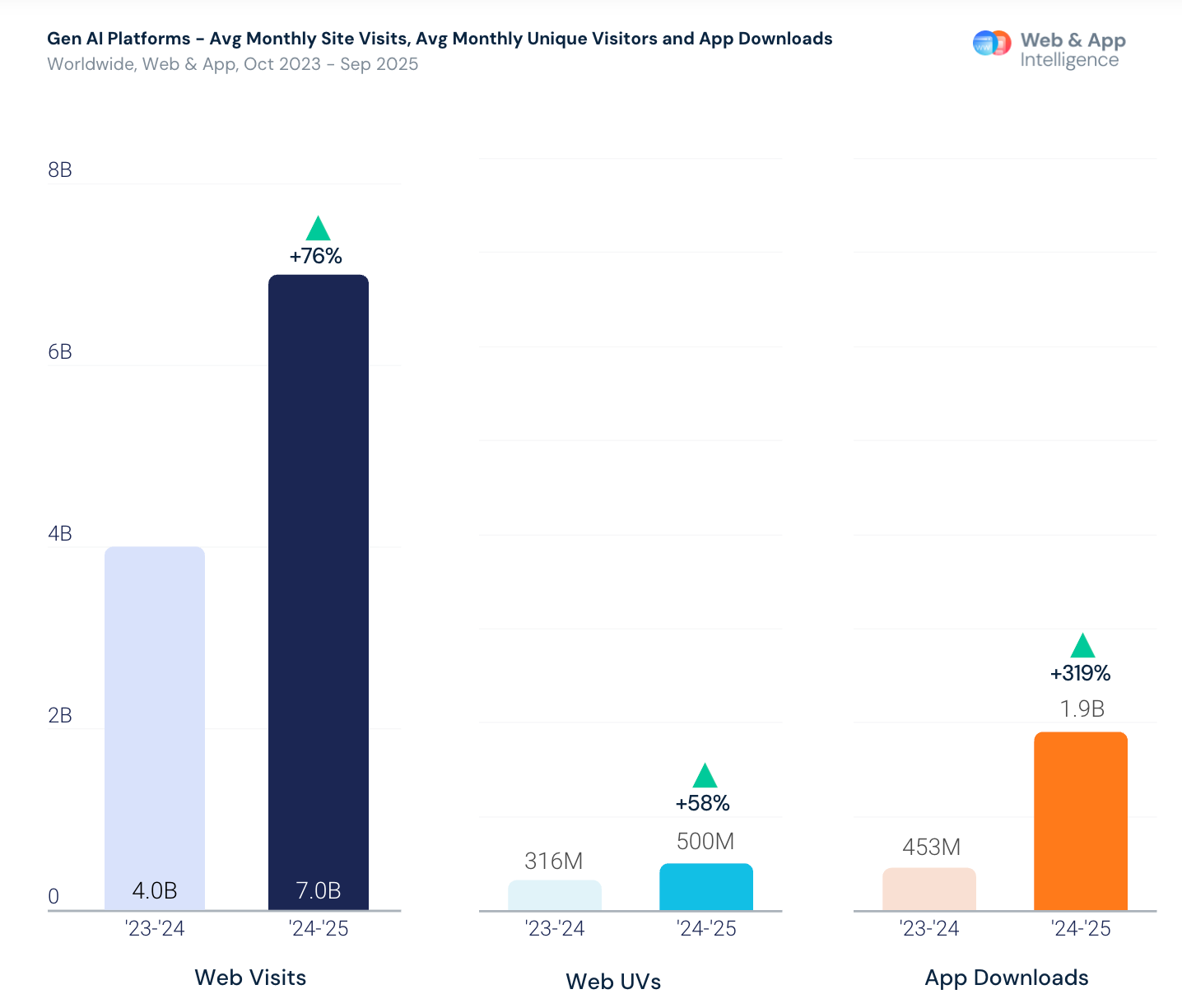
Let’s start with the basic picture the report draws. GenAI is growing extremely fast on both the web and mobile. Similarweb shows that GenAI websites reached +76% YoY growth in average monthly visits, which means people are coming back again and again, not just trying these tools once. On mobile, adoption is even more aggressive: GenAI app downloads are up 319% YoY. Think of it this way: web growth tells us GenAI is becoming a daily habit, while app growth tells us users want these assistants always available on their phones — like a new default utility.
Source: Similarweb.com
Which AI Tools Lead in 2025?
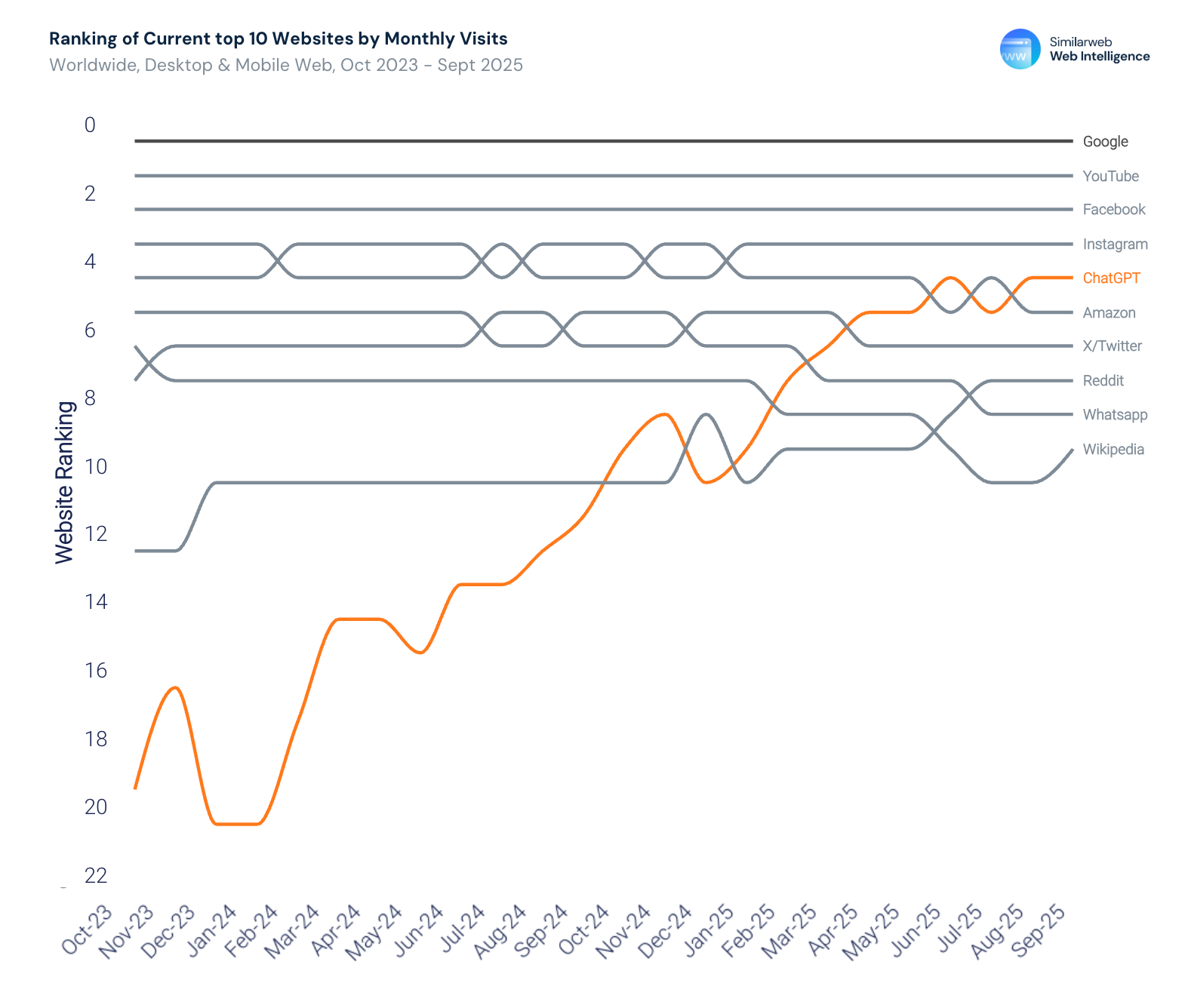
Even though many GenAI tools are launching, user attention is still highly concentrated. Similarweb shows that ChatGPT has become a true internet giant — by 2025, it broke into the global top-5 websites by monthly visits, sitting alongside the biggest platforms on the web.
Source: Similarweb.com
It also dominates the GenAI category itself, accounting for nearly 80% of global GenAI visits. The simple picture here is that the market is expanding rapidly, but most people still start their GenAI journey in one place.
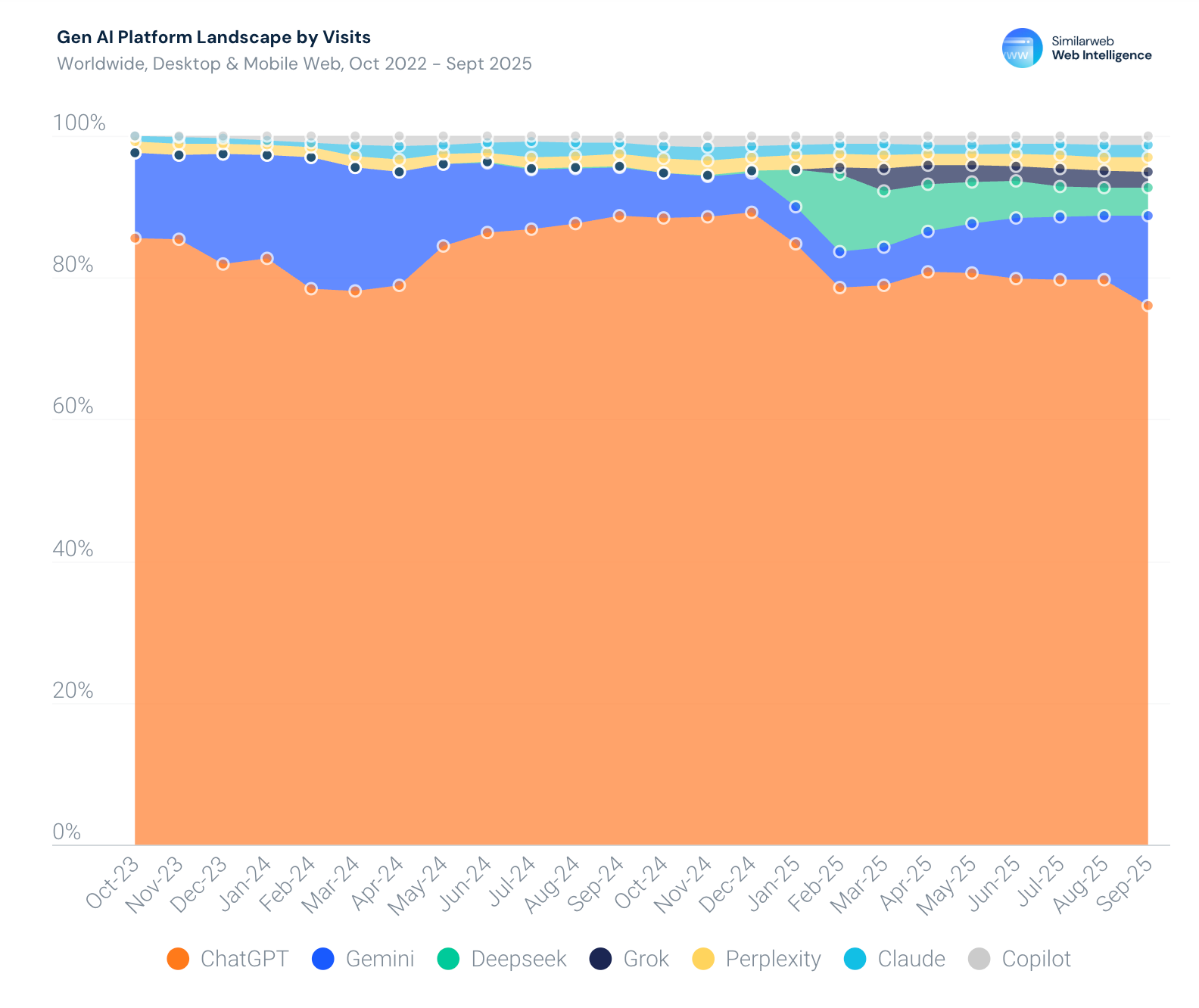
Source: Similarweb.com
Mobile usage tells the same story, with a more apparent split between “scale” apps and “specialist” apps. In the US, ChatGPT leads by a wide margin with 41.3M monthly active users and 33% stickiness, meaning about a third of its users open it daily. Other apps are much smaller but serve more specific needs: Perplexity, Copilot, Gemini, Claude, and others have low single-digit millions of MAU, with varying levels of daily use. So the hierarchy looks like this: one mainstream hub for the mass audience, plus a growing set of niche tools for particular tasks.
How Search Intents Are Changing?
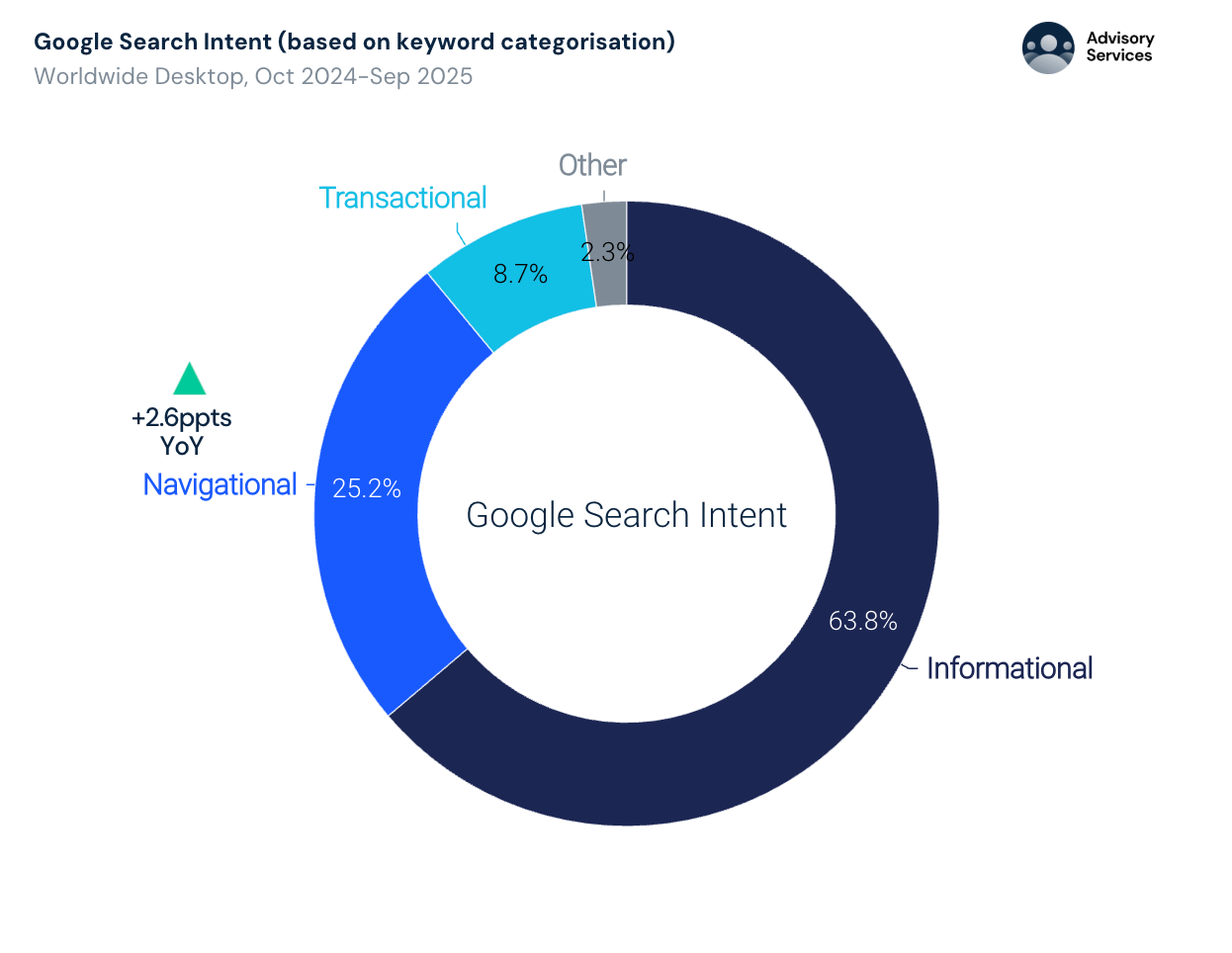
The report shows that AI changes search by altering what people are trying to do. In Google Search, most activity still follows the classic pattern: 63.8% of searches are informational and 25.2% are navigational, meaning users mainly want facts or a specific site. Transactional searches are smaller at 8.7%.
Source: Similarweb.com
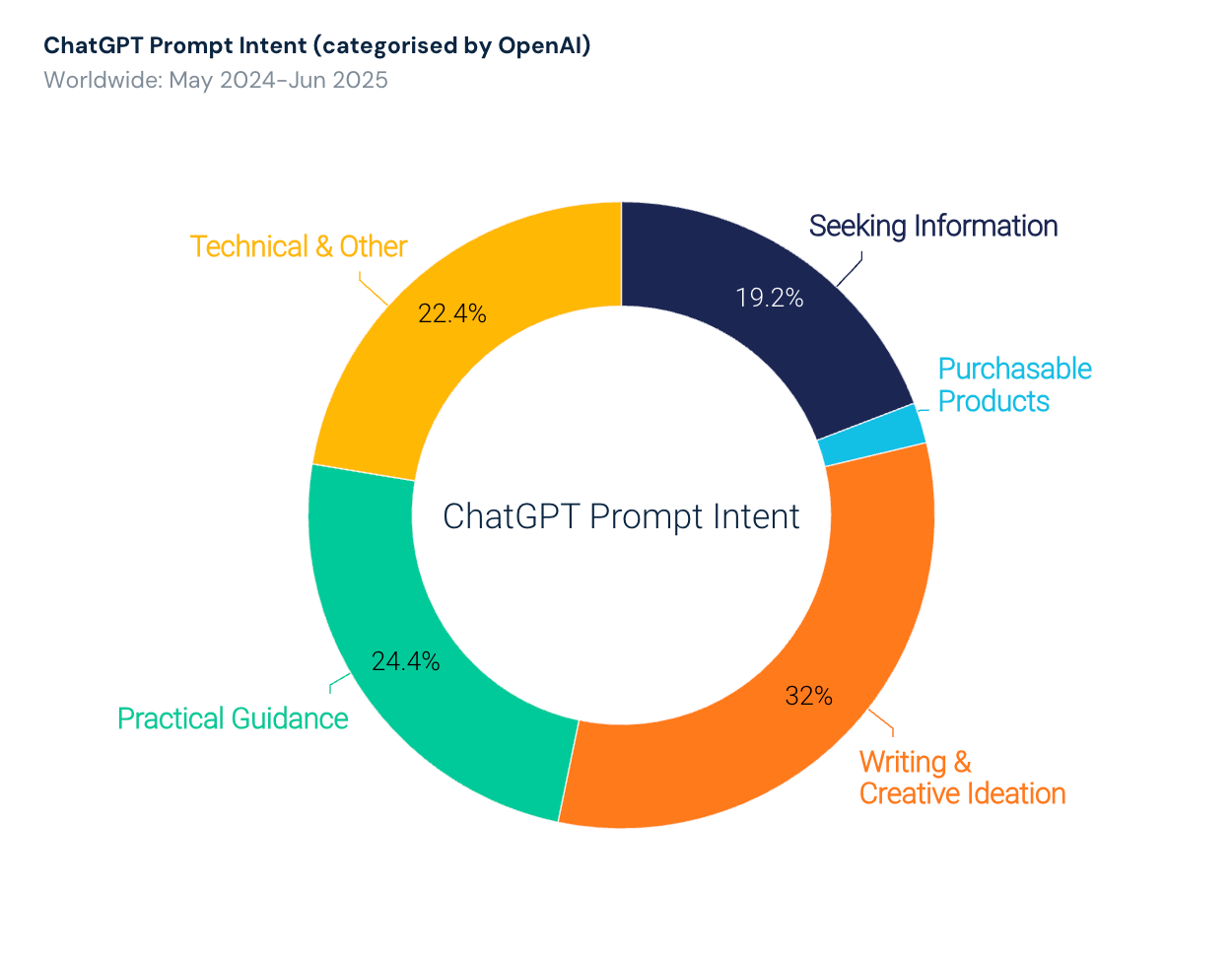
ChatGPT sessions show a different kind of intent. Only 19.2% of prompts are purely information-seeking — instead, people mostly use it for tasks: 32% for writing and creative ideation, 24.4% for practical guidance, and 22.4% for technical or hands-on help. Even shopping-related prompts exist, but they still make up only a small slice at 2.1%. Put simply, Google is still for “find and go”, while GenAI is for “think, create, and decide”.
Source: Similarweb.com
You can also see this shift in how people phrase questions. Similarweb measures the average query length: Google searches are short (3.4 words on average), AI Mode queries are longer (10.4 words), and ChatGPT prompts are much longer and more detailed (about 60 words). That’s a clear sign of conversational AI search. Users provide more context, ask multi-step questions, and expect a guided answer rather than a list of links.
So, search is becoming less about finding pages and more about getting guidance. Users now have multiple starting points, and GenAI is evolving into a platform where intent and preferences are shaped before clicks occur.
AI Search Sources 2025: What ChatGPT and AI Mode Rely On
GenAI search works differently from classic search for two reasons: people use it to think and decide in conversation, and the models build those conversations from sources they trust. So instead of scanning links first, users often get AI answers and recommendations inside the LLM — and only then click out. Similarweb’s citation data shows exactly which sources shape those AI answers.
When ChatGPT generates responses, the biggest share of citations comes from News & Publishers (36.9%), followed by Reviews and UGC (18.9%). Other categories play more minor roles, such as Business Services (11.4%), Social Media (8.7%), and Ecommerce Brands (7.8%). AI Mode follows the same general pattern: News & Publishers lead (34.5%), while Reviews/UGC are even stronger there (26.9%). In simple terms, GenAI tools lean more on authoritative media and real user commentary than on brand-owned pages.
This matters because it tells us where influence in AI discovery is coming from. If LLMs build their answers from publishers and community-driven reviews, then those places shape what users see, trust, and choose inside the conversation. So for advertisers, the question is no longer only “where do users click?” but also “where does the model look when forming its recommendation?”
GenAI as a Traffic Source
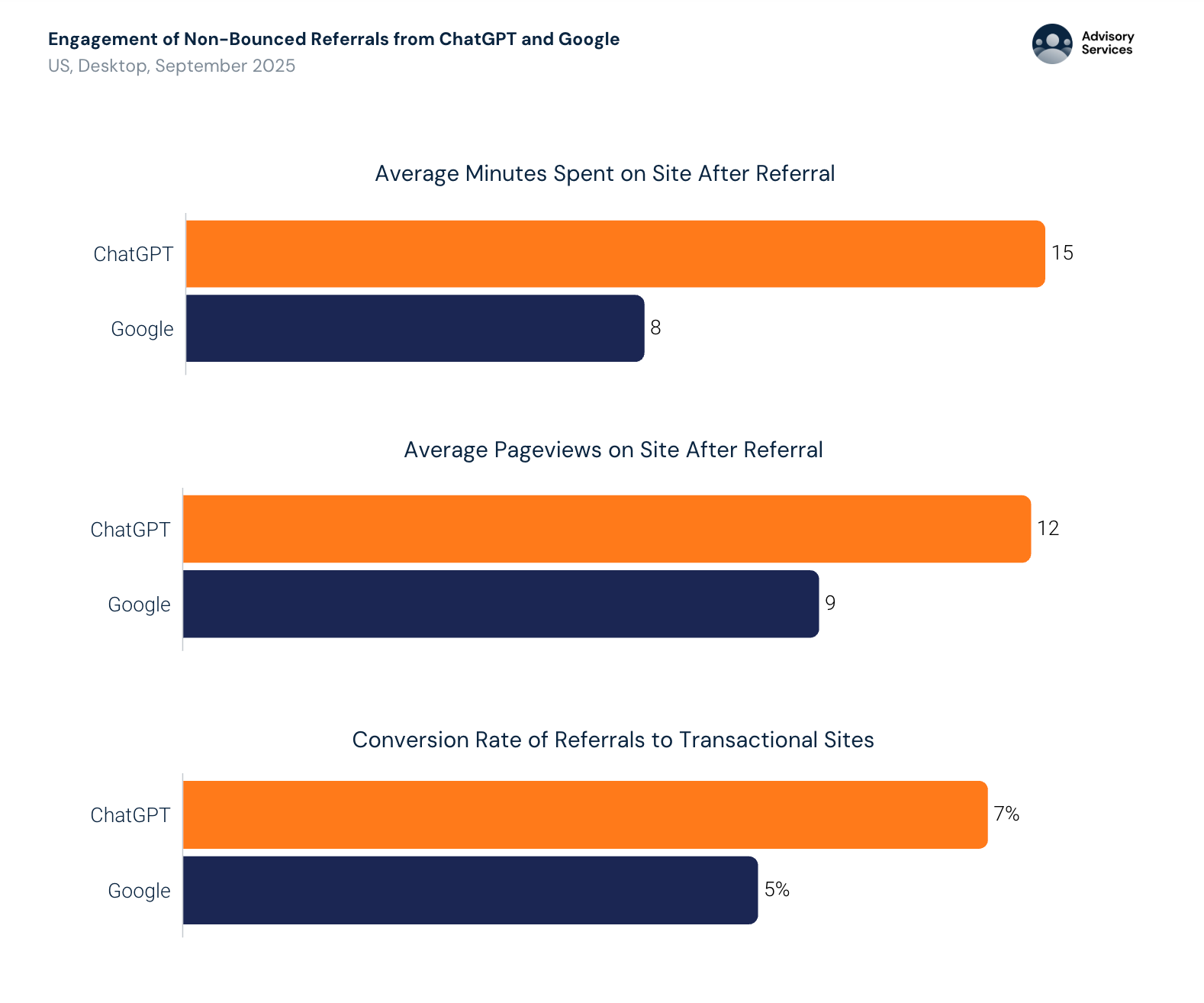
Similarweb’s data highlights a practical shift for advertisers: GenAI is no longer just a place where people ask questions — it’s becoming a real source of decision-ready traffic. Referrals from GenAI platforms to transactional sites already convert strongly at around 7%, outperforming traditional search referrals in the report’s comparison. After the click, users also behave like high-intent visitors: traffic from ChatGPT spends about 15 minutes on the site on average, versus 8 minutes for Google traffic, and views more pages. In simple terms, GenAI clicks tend to happen after the user has already clarified options inside the conversation, so the visit that follows is closer to action.
Source: Similarweb.com
At the same time, Similarweb notes that outbound referrals are beginning to plateau by late 2025. So the key implication is not “more clicks will automatically come”, but that the clicks GenAI does send are already unusually valuable — and advertisers should plan for influence and efficiency, not just scale, as this channel matures.
GenAI Visibility: What Makes LLMs Cite Your Content
Similarweb introduces AI visibility in LLMs as a new way to think about search competition. In a world where users ask LLMs to compare and recommend, brands don’t only compete for clicks — they compete for being mentioned and cited inside AI answers. The report suggests tracking visibility the same way we track classic share of voice: who shows up in answers, how often, and in what context.
Similarweb also explains what makes a page “visible” to LLMs. Models don’t rely on homepages much — they pull most citations from deeper site layers (often at folder depths 2–4). So the content that shows up in AI answers is usually practical and specific: guides, FAQs, category pages, or detailed product pages — not top-level brand messaging.
The report also shows that structure matters: when information is clearly organized and easy to scan, LLMs are more likely to use it. The takeaway is that in GenAI search, visibility comes from deep, well-structured content, not just a strong top-level brand presence.
Key Takeaways
Similarweb's report provides a clear outlook for 2025. Generative AI is already a mainstream behavior layer: GenAI platforms average 7.0B monthly web visits worldwide (+76% YoY), and GenAI apps hit 1.9B downloads (+319% YoY). User attention is still concentrated around a few leaders, with ChatGPT acting as the main hub, while other tools grow into more specialized roles. At the same time, search itself is changing: people increasingly use LLMs for decision and task-based intents, and they ask longer, more contextual questions in conversation. Finally, the content that influences AI answers comes mostly from publishers and UGC, and LLMs tend to cite deep, well-structured pages rather than homepages.
For advertisers, the implication is simple but essential. GenAI is already shaping choices early in the funnel and sending high-intent traffic when users click out — even though outbound growth is starting to level off. So the opportunity in 2025 is not just to chase more clicks, but to earn visibility inside AI answers by being present in trusted sources and by building deep, structured content that models can confidently cite.