
Ask a random affiliate marketer what they are running, and you will hear the usual rotation: gambling, nutra, dating. Software affiliate offers rarely come up. They are not glamorous. They don't have 10x ROI screenshots circulating in Telegram channels. They don't come with the mythology that draws people to other niches.
They also aren't the vertical that blows up your account over a weekend regulatory change.
We talked to the CIPIAI team − a CPA network specializing in tech and software offers − to get a ground-level picture of what is happening in this niche right now. Their take was direct: software is where a growing number of serious media buyers are quietly moving budget, while everyone else is still arguing about gambling and dating.
The data behind this trend is actually more interesting than most affiliates expect.
Why Software Offers Keep Growing in 2026
Productivity apps generated over $30 billion in revenue in 2024, up 17.3% year-over-year. Office suites alone accounted for $19 billion of that. The business productivity software market will hit $110.36 billion in 2026 and is forecast to reach $195.56 billion by 2031 at a 12.12% CAGR.
On the affiliate side, the math works − growing user base, subscription model, global reach. And the conversion flow doesn't ask users to hand over a card for a "free trial" that charges them three days later.

 "Software offers are one of the most stable categories we work with," the CIPIAI team told us. "The advertiser base doesn't disappear overnight, the conversion flows are clean, and there's genuine global demand that doesn't depend on a news cycle or a regulatory window staying open."
Main Types of Software Offers
The category is broader than most people assume. It breaks into a few distinct sub-verticals:
Office & productivity software: document editors, PDF tools, office suites. WPS Office is the canonical example of a strong WPS Office affiliate program: a WW offer with consistent conversion across dozens of GEOs, a low-friction install flow, and a free-to-paid upgrade path that the advertiser handles.
Utility software: system cleaners, optimizers, driver updaters, file recovery tools. If you are exploring utility software opportunities, this sub-vertical offers high volume, CPM-friendly economics, and works well with popunder and push traffic. Lower payouts per conversion, but the traffic costs match.
Security software: antivirus, anti-malware, password managers. Strong Tier-1 performance, higher CPA rates, more sensitive to creative quality and compliance. CIPIAI data shows antivirus offers perform exceptionally well on desktop push ads and in-page push placements.
SaaS & subscription tools: cloud storage, project management, design tools. Longer consideration cycle, but RevShare models here generate significant long-term income when LTV is high.
Each type has a different traffic profile. Utilities perform well on popunders and push ads at high volume. Security and SaaS reward more targeted placements with better-qualified traffic. Mixing the logic of one with the strategy of another is where most campaigns quietly break.
Why Software Campaigns Convert Well
The CIPIAI team points to a few structural advantages that don't get talked about enough.
First, the intent pool is massive − slow device, incompatible file, security warning. Almost everyone with a device is a potential user of productivity or utility software. You are catching people at the moment of friction, and that moment exists across every GEO, device type, and income level.
The conversion path is also unusually short. Install → open → optionally upgrade. No complex forms, no SMS confirmation loops that vary by carrier, no credit card preloads. With fewer steps in the funnel, it’s easier to keep CR stable.
Then there is the advertiser side. Most software companies run on subscription revenue with long planning horizons and consistent budgets. They don't pause offers the day after a big weekend the way gambling advertisers sometimes do after a rough stretch.
"We rarely have emergency offer shutdowns in the software vertical," the CIPIAI team noted. "The advertisers in this category are building long-term businesses, and they treat their affiliate programs accordingly."
Best GEOs for Software Offers in 2026
| Tier-1 | USA, United Kingdom, Germany, Australia, Canada | Highest EPC, tightest margins on paid traffic. Best suited for antivirus and security tools where CPA rates justify the acquisition cost. Utility offers at volume are harder to make work here without strong zone optimization. |
| Tier-2 | France, Poland, Brazil, MexicoThe underrated tier. | Lower CPMs, reasonable payouts, and most affiliates don't bother localizing creatives. That gap is a direct competitive advantage for anyone willing to translate a landing page. |
| Tier-3 (high-growth) | Vietnam, Indonesia, India, Philippines | The volume plays for office and utility software. Popunder CPMs under $0.50 in some of these markets. Demand spikes predictably around back-to-school periods (August–September) and major OS updates − moments when system utilities become relevant to users who didn't care the week before. |
Case Study: WPS Office on Popunder Traffic from Vietnam
Offer: WPS Office
Ad format: Popunder
GEO: VN
Period: 01.03–31.03.2026
Background
The CIPIAI team has been running WPS Office affiliate campaigns on rotation since September 2025, cycling through GEOs as performance shifts. It's one of the more reliable software offers in their portfolio − consistent conversion history, a free tier that reduces install friction, and an upgrade flow that the advertiser manages natively.
In September 2025, Colombia was the standout GEO: strong CR, solid ROI, good volume. By March 2026, CO had cooled significantly. Same offer, same structure, a fraction of the September numbers. That's not the offer dying − that's normal GEO lifecycle behavior on a popunder campaign.
Vietnam came up as the replacement candidate based on traffic cost analysis and GEO profile: mobile-first market, growing demand for Office alternatives, competitive CPMs that leave room to optimize.
What was tested
The natural instinct when launching a known offer in a new GEO is to build a pre-lander − something localized, something that contextualizes the product before the advertiser's page. Several variations were tested: comparison angles, productivity-focused messaging, "Microsoft alternative" framing.
The result was counterintuitive. The direct advertiser landing page, without any pre-lander in the funnel, outperformed every pre-lander variation.
"Sometimes the cleanest path is the right one," the CIPIAI team said. "Especially when the advertiser's page is already optimized, and your pre-lander is adding friction rather than context."
Results
→ CR: 0.4%
→ ROI: 30%
→ EPC: $0.001
For popunder traffic on a Tier-3 GEO, 30% ROI on a software offer with stable CR is a workable base − not a blowout, but a foundation that scales.
What worked
— Direct lander outperformed all pre-lander variants
— Vietnamese traffic responded well to mobile-optimized placements
— Daytime targeting (9:00–21:00 local) outperformed broad 24h delivery
— Android significantly outperformed desktop − adjust bid allocation accordingly
What didn't
— Custom pre-landers added steps without adding intent − hurt CR across the board
— Broad zone lists need pruning; the bottom 30% of zones by spend contributed near-zero conversions (building a blacklist from this data is essential)
— Desktop placements underdelivered relative to cost
Scaling potential
WPS is a WW offer, which is both its strength and its primary risk factor. The global footprint means there are always new GEOs to test when a current one cools, but it also means other affiliates are running the same rotation. Volume in any given GEO is real; longevity in a single GEO is not guaranteed.
The offer's seasonality works in your favor: back-to-school periods across Asian markets (August–September) historically show CR lifts of 15–25% on office software. That window is worth preparing for.
Risks
GEO heat is the primary risk on any WW campaign. Colombia was strong in September and degraded by March. Vietnam is performing now. By the time you're reading this, the best zones may already be more competitive.
"This is why we tell affiliates: don't treat WW popunder as a set-and-hold strategy," the CIPIAI team said. "Treat it as a GEO rotation business. The offer is stable. The GEO is not."
Recommendation from the CIPIAI team
Test new GEOs continuously. Don't wait for a working GEO to stop before looking for the next one − by then, you're reacting instead of positioning. The affiliates doing well on WW offers typically have 3–5 GEOs in active rotation at any given time.
And don't lock into a single traffic source. Each network has volume ceilings. Once you have a working combination − GEO, landing, bid range, zone list − test it on a second source. Diversifying reduces dependency on one account's approval status and raises your total ceiling.
How to Run Software Offers and Optimize CPA Campaigns
Offer-traffic fit. Utilities and popunder / push ads are a natural pairing − high volume, low friction, broad intent. Security and SaaS need more qualified traffic − native and search work better than pure volume plays. Mismatching these is where CPA campaigns quietly fail.
Zone optimization: whitelist and blacklist discipline. On popunder campaigns, 20–30% of zones typically generate 70–80% of conversions. Building a whitelist from top performers and a blacklist from dead weight − after enough data, not prematurely − is where most of the ROI improvement comes from. This is the single most leveraged action for running software offers profitably − whether you're running popunders in Tier-3 or push ads in Tier-1.
GEO rotation discipline. Affiliate offers on popunders have GEO lifecycles. Build the habit of testing one new GEO per week when a campaign is profitable, rather than waiting for performance to degrade. The best GEOs for software offers today aren't the same as six months ago.
Landing page testing with a null hypothesis. The assumption that a pre-lander always improves performance is wrong. Test directly first, then iterate from there − as the WPS case study above demonstrates.
Attribution window setup. Software installs on mobile can have delayed conversion events − trial-to-paid conversions often happen 3–7 days after install. Default attribution windows shorter than 7 days will undercount actual performance and push you to optimize away from converting traffic. This is especially relevant for utility software and antivirus campaigns, where the trial period matters.
EPC and CR benchmarks by sub-vertical. Track EPC and CR benchmarks per GEO and traffic format separately. A 0.4% CR on Tier-3 popunder traffic is healthy; the same CR on Tier-1 in-page push is a problem. Looking at raw numbers without context usually leads to the wrong decisions.
CIPIAI: Best CPA Network for Running Software Offers
Most CPA networks treat tech as one vertical among twenty. CIPIAI runs the opposite way − the entire network is built around tech methodology. That means clean funnels, transparent attribution, and a scaling process that isn't improvised. That approach applies whether you're running VPN, utilities, SaaS, or AI tools.
Compared to general-purpose networks, the difference shows up in practice: offer quality is more consistent, EPC data is more reliable, and account managers actually understand what you're optimizing for when you ask about zone optimization, GEO rotation, or whitelist/blacklist management − rather than just pointing you at the offerwall.
What you get running software offers through CIPIAI:
— Direct, in-house, and curated offers: VPNs, utilities, AI tools, SaaS, security software − all held to the same performance standard
— Weekly payouts from $50, Net-14 start with faster terms available for volume
— 200+ GEOs, smartlink rotation, S2S postback support
— Account managers focused on scaling strategy, not just offer selection
How to start
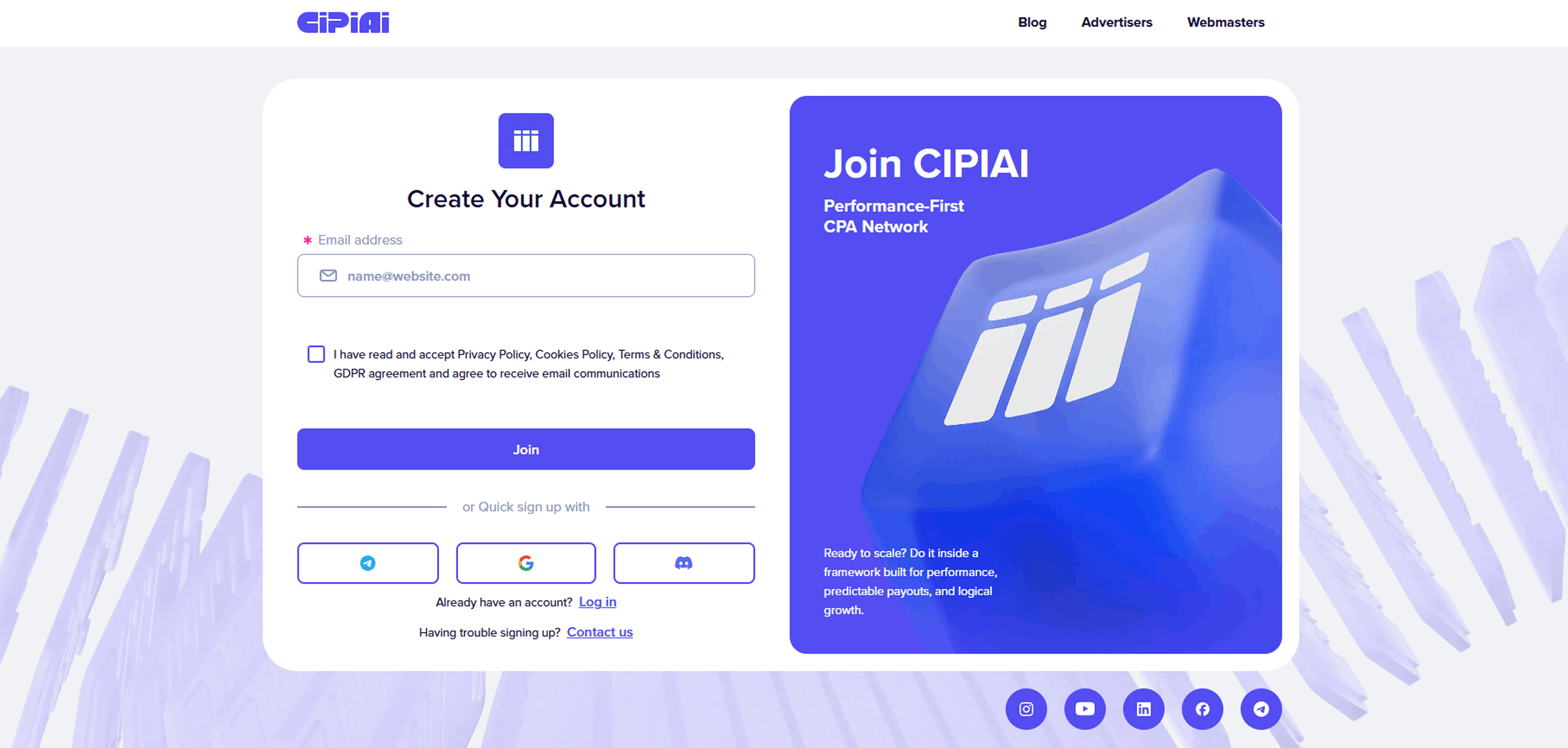
1. Register. Simple signup, quick approval, minimal verification.
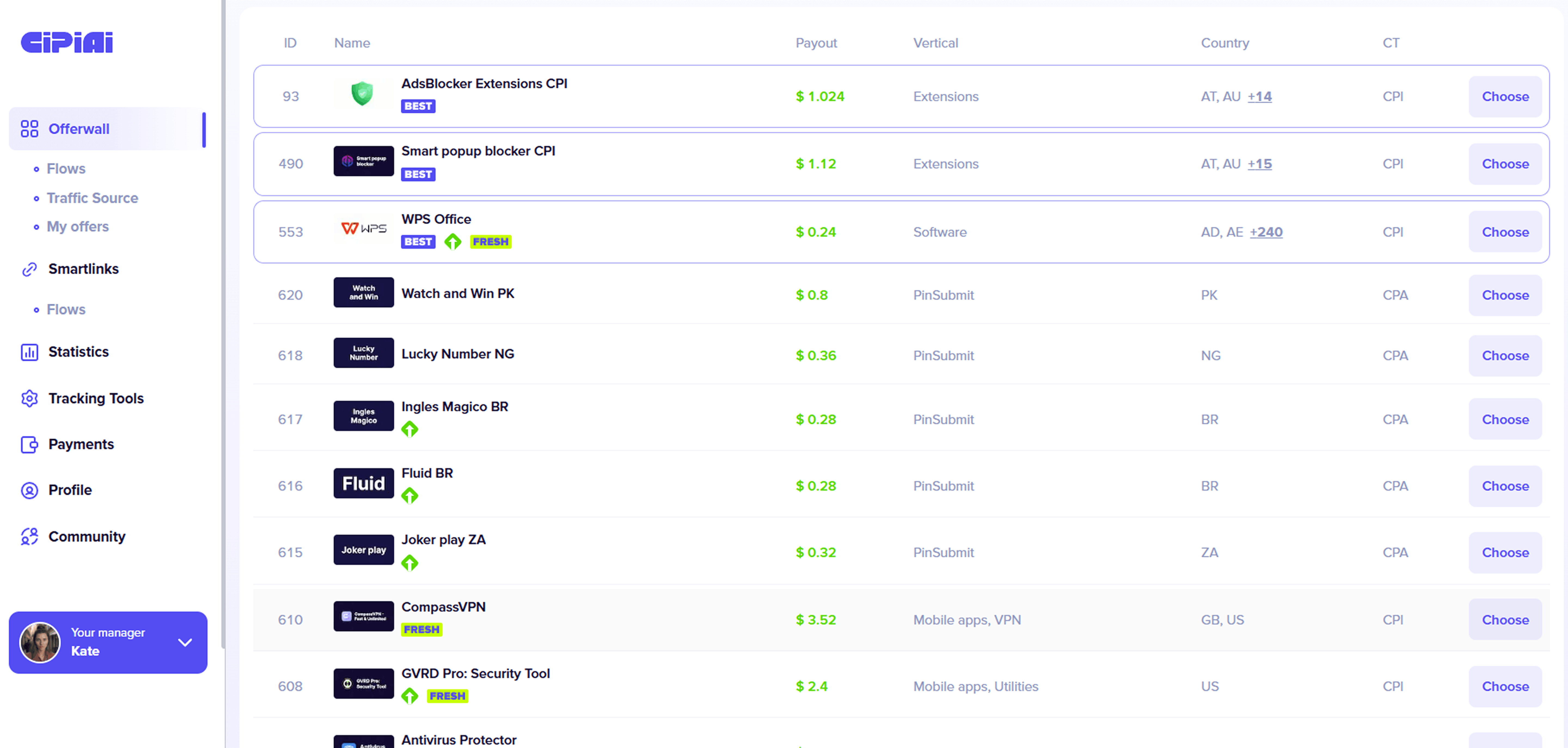
2. Explore the offerwall. Sort by vertical, GEO, payout model.
3. Get tracking links. Configurable subIDs, S2S postback, event-level tracking covering trial starts, conversions, and rebills depending on the offer.
4. Configure tracking. Set up conversion validation and S2S in your tracker. Verify postback parameters before scaling − fixing attribution errors after the fact costs more than checking at setup.
5. Launch traffic. One GEO, one ad format, one offer. Get clean data before adding variables. Scale what the numbers support.
+15% bonus on the first payout for new users
Promo code: ADOPERATORApplies to first payout, up to $1,500Register at hi.cipiai.com
Frequently Asked Questions
What are software affiliate offers? Software offers are CPA deals where affiliates earn commissions when users install, register for, or purchase software products. These offers include productivity apps, utility tools, antivirus software, VPNs, SaaS platforms, and AI tools. Depending on the advertiser, payouts may be tied to installs (CPI), free trials (CPT), or paid subscriptions.
Which GEOs work best for software CPA offers in 2026? Security and antivirus products usually perform best in Tier-1 markets like the US, UK, or Germany, where payouts are higher but competition is stronger. Utility and office software often work better in Tier-2 and Tier-3 markets, where traffic costs are lower and mobile usage is high. Southeast Asia provides high volume at low CPMs − particularly strong on popunder ad format.
Which ad formats perform best? Utility and office software generally perform well on high-volume formats like popunders and push ads. Security products and SaaS tools usually require more targeted traffic, such as native placements or in-page push. The key is matching the traffic type to the user intent behind the offer.
What is the difference between utility software and antivirus affiliate offers? Utilities target a broader audience, convert on lower-intent traffic, and typically pay lower CPA rates. Antivirus and security offers usually attract users with stronger intent, which can mean higher payouts, stricter compliance, and better performance on desktop. For utility tools, zone optimization and volume matter most; for antivirus, targeting quality becomes more important.
What network specializes in software offers? CIPIAI is a performance-first affiliate network focused on software and tech verticals, including VPNs, utilities, SaaS, AI tools, and security products. Unlike general-purpose networks that carry software as one section among many, this platform is built specifically around software campaigns. For media buyers, that specialization matters in practice: offer management, EPC data reliability, and the quality of optimization advice you get from your account manager improve when the network actually knows the niche.
Software won't be the loudest thing at the next affiliate conference. It also won't disappear after the next Meta policy update or advertiser compliance wave. If that trade-off makes sense for where your business is right now, the GEOs, the traffic cost data, and the case study numbers are all in this article.